How to Raise a Confident Child: 5 Identity-Based Strategies That Actually Work
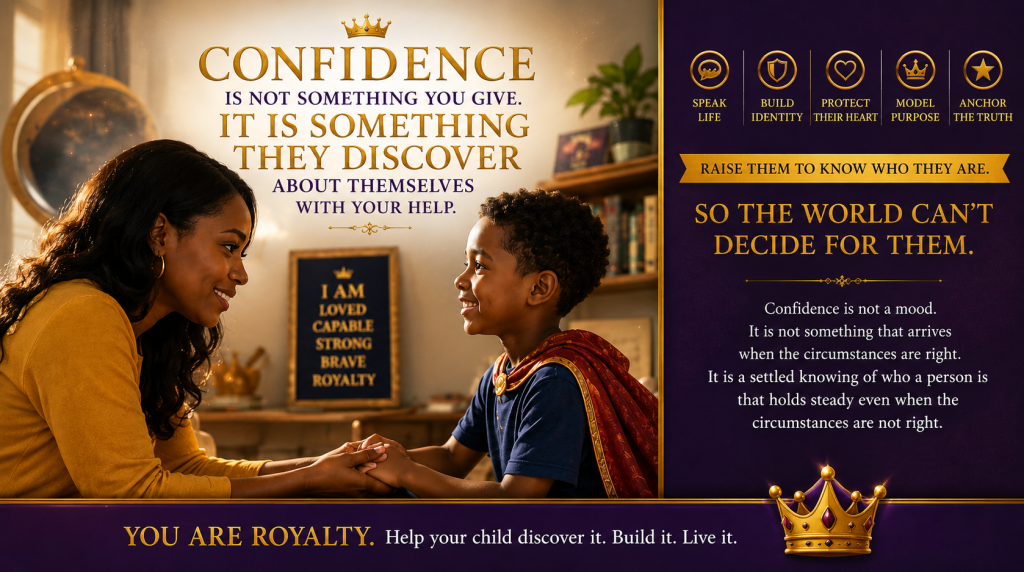
Confidence is not something you give a child. It is something they discover about themselves with your help.
If you have typed “how to raise a confident child” into a search engine at 11pm, chances are you have already tried the obvious things. You have affirmed. You have encouraged. You have sat beside your child and told them they are wonderful and watched those words slide right off them without leaving a mark.
You are not failing. You are missing one thing: the difference between words spoken over a child and an identity built inside one. Confidence is not a mood. It is not something that arrives when the circumstances are right. It is a settled knowing of who a person is that holds steady even when the circumstances are not right. And for children growing up in a world of comparison, social media, peer pressure, and relentless external noise, that settled knowing has to be deliberately, consistently, and strategically built.

Here are five strategies that work. Not because they are clever, but because they reach the right place.
1. Name their greatness specifically, not generally
Most parents say, “You are amazing.” What a child’s brain actually registers is, “You are amazing at this specific thing that I have clearly noticed.” Generalized praise is easy to dismiss. Specific observation cannot be argued with. Instead of “you are so smart,” say: “I noticed how patiently you figured out that puzzle without giving up. That kind of persistence is going to take you far.” The more specific the observation, the deeper it lands.
2. Give them words to say about themselves every morning
Neuroscience is unambiguous on this: what a child tells themselves about who they are — especially in the morning, before the world begins to compete for their narrative — measurably shapes their self-concept, their emotional resilience, and their response to adversity. A simple spoken creed, said daily for thirty consecutive days, begins to rewire how a child sees themselves. Not because the words are magic, but because repetition is how identity is formed. Children who practice daily spoken affirmation show measurable improvements in confidence, peer relationship quality, and emotional regulation within four to six weeks.
Our book You Are Royalty includes a personally crafted creed for children ages 5 to 7, and They Are Not Kids includes one for ages 8 to 12. These are not generic feel-good statements. They are theologically grounded, emotionally specific declarations that speak directly to the fears and comparison traps most children face.
3. Protect their inner world from constant comparison
Comparison is the primary mechanism through which childhood confidence is destroyed. Not bullying. Not failure. Comparison. The child who compares themselves to a sibling, a classmate, an Instagram image, or a parent’s standard they can never quite meet internalizes the message that their current self is insufficient. Guard the comparison entry points. Limit unsupervised social media. Explicitly name comparison as a thief in your home. And when you catch your child doing it, do not dismiss it — name what you see: “I notice you are measuring yourself against someone else right now. Can we talk about what your own greatness looks like?”

4. Let them see you fighting for their identity
Children know when the encouragement is perfunctory and when it costs you something. The parent who sits down and says, “I want to tell you something I have been thinking about for a while — here is what I genuinely see in you” — that conversation lands differently than praise offered in passing. Make your belief in your child feel deliberate. Make it feel like something you carry and think about and mean. That level of intention communicates to a child’s nervous system: I am safe. I am seen. I am worth someone’s deliberate attention.
5. Anchor their confidence in something that does not move
The deepest, most durable form of childhood confidence is not rooted in performance, appearance, or peer approval. All of those fluctuate. It is rooted in identity — specifically, in the knowledge that they were made on purpose, by a God who does not make mistakes, for a purpose that is already in them waiting to unfold. A child who knows they are a child of the King does not need the approval of their classmates to walk into a room with their head up. They carry their crown regardless of who notices it.
This is the foundation on which both books in this series are built. Not self-help. Identity. Not performance. Royalty.
“A confident child is not a child who has never been hurt. It is a child who knows who they are when the hurting is done.”
You Are Royalty (Ages 5–6) and They Are Not Kids, They Are Kings and Queens (Ages 8–12) are available now. Give your child the words that build the foundation that nothing can shake. → niiodehe.com